
Neurology & brain health
Heel Spur: What It Is, Symptoms and Treatment
Oct. 20, 2026 · 4 min ·
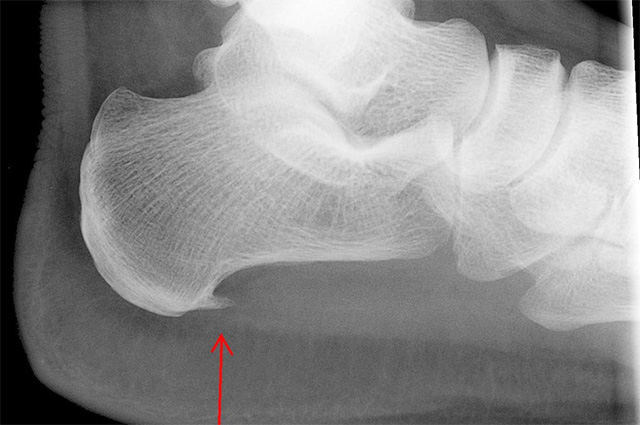
If your heel hurts when you take your first steps in the morning, or when you stand up after sitting for a while, you may have a heel spur. One thing is worth clarifying from the outset: the spur shows up on the X-rays of many people who feel no pain at all. What usually hurts is not the bony point itself, but the inflamed plantar fascia that pulls on it. That is why treatment is aimed above all at that inflammation. In this article we explain what a heel spur is, how it is diagnosed and what options exist to relieve the pain, from insoles and exercises to shockwave therapy.
What Is a Heel Spur?
A heel spur is a small bony prominence that forms on the underside of the heel bone (the calcaneus), right where the plantar fascia inserts - the band of tissue that runs along the sole of the foot. It develops gradually, as the body's response to repeated strain in that area.
The most widespread idea - that the spur "digs in" and therefore hurts - does not match what is seen in the clinic. The extra bone can be present for years without causing trouble. The pain appears when the plantar fascia becomes irritated and inflamed, a condition called plantar fasciitis that often accompanies the spur. Understanding this difference helps in choosing the right treatment.
Symptoms of a Heel Spur
The main symptom is pain at the base of the heel with a fairly characteristic pattern:
-
Pain on the first steps, when getting out of bed in the morning or after sitting for a while. It usually improves after walking a little and returns after rest.
-
Discomfort when standing for long periods or walking on hard surfaces.
-
A localised point of pain on the inner side of the heel that you notice when you press it with a finger.
The pain may come and go over weeks or months. In some cases it stays steady, and in others it worsens if the area is not looked after.
Heel Spur and Plantar Fasciitis: How They Differ
These are two different things that frequently appear together, and it is worth not confusing them.
|
Heel spur |
Plantar fasciitis |
|
|
What it is |
Bony prominence on the heel |
Inflammation of the plantar fascia |
|
Seen with |
X-ray |
Clinical examination and, if needed, ultrasound |
|
Does it always hurt? |
No; often an incidental finding |
Yes, it is the usual cause of the pain |
|
What is treated |
Rarely the bone itself |
The inflammation and the overload |
In practice, when plantar fasciitis is treated well, the pain improves even if the spur is still there. If you want to go deeper into fascia inflammation, you can read our article on plantar fasciitis.
Causes and Risk Factors
The spur develops from sustained strain on the plantar fascia. The factors that have the most influence are:
-
Excess weight, which increases the load on the heel with every step.
-
Unsuitable footwear, with little support or a very thin sole.
-
Running or walking a lot, especially on hard surfaces or with a sudden increase in activity.
-
The shape of the foot: flat foot or, conversely, a very high arch.
-
Age, because over the years the fascia and the fatty pad of the heel lose elasticity.
Several factors often combine at once. Identifying them is part of treatment, because reducing the cause is what stops the problem from coming back.
Diagnosis: When an X-ray Is Needed
Diagnosis begins with a consultation in which the doctor asks about the type of pain and examines the foot. In many cases, the history and the examination are enough to guide treatment.
An X-ray confirms the presence of the spur and helps rule out other causes of heel pain, but it is not essential in every case: remember that seeing a spur on the image does not mean it is responsible for the pain. Ultrasound is useful for assessing the state of the plantar fascia, which is what tends to be inflamed.
Treatment of a Heel Spur
Most cases improve with conservative measures, that is, without surgery. The goal is to reduce the inflammation, offload the area and correct whatever is overloading the heel.
Insoles and Heel Cups
Insoles with arch support and silicone heel cups cushion the impact and distribute the load better. They are one of the first measures recommended because they relieve the pressure on the heel with every step. Ideally the insole should fit the shape of your foot; in some cases custom-made insoles are recommended.
Exercises and Stretches
Keeping the plantar fascia and the calf muscles flexible reduces the strain on the heel. These exercises are usually part of treatment:
-
Plantar fascia stretch. Sitting down, cross the painful foot over your other leg, hold your toes and pull them gently back until you feel tension in the sole. Hold for 20–30 seconds and repeat several times.
-
Calf stretch against the wall. Standing facing a wall, step one leg forward and straighten the back leg with the heel resting on the floor. You will feel tension in the back of the leg.
-
Rolling a ball or a cold bottle under the sole of the foot for one or two minutes. The cold adds an anti-inflammatory effect.
-
Picking up a towel with your toes, to activate the muscles of the sole.
They should be done consistently and without forcing into pain. If a discomfort increases rather than improves, it is better to have it checked.
Shockwave Therapy for a Heel Spur
When the pain does not ease with the previous measures, one of the best-supported options is shockwave therapy (ESWT). It is a non-invasive procedure: an applicator transmits acoustic waves to the heel area to stimulate circulation and tissue repair processes, and so reduce the pain of the inflamed fascia.
According to the available studies, shockwaves can improve chronic heel pain in many patients who had not responded to other treatments. The number of sessions is adjusted to each case; it is usually between 3 and 5 sessions, normally one a week, and the doctor defines the exact number after assessing your heel.
At the clinic we deliver this shockwave therapy treatment with STORZ MEDICAL equipment, within a plan that combines the therapy with the rest of the measures (insoles, exercises and correction of the overload). You can see how we work on musculoskeletal pain in our orthopaedics section.
When Is Surgery Considered?
Heel spur surgery is uncommon and is reserved for cases in which the pain persists for many months despite having tried, correctly and consistently, all the conservative options. Most people never need it.
When to See a Doctor
Ask for a medical assessment if:
-
Heel pain lasts more than two or three weeks or limits you from walking or working.
-
Swelling, redness or warmth appears in the area.
-
The pain is very intense after a fall or a blow, to rule out a fracture.
-
You have diabetes or circulation problems and you notice pain or changes in the foot.
Shockwave therapy and other treatments have contraindications (for example, pregnancy, certain clotting disorders or infections in the area), so they are always assessed individually before starting.
Frequently Asked Questions
Does a heel spur go away? The bony point usually does not disappear, but that is not the important issue: what is treated is the pain, and in most cases it is well controlled with conservative measures even if the spur remains on the X-ray.
How many shockwave sessions are needed? It depends on the person and on how long the pain has been present. The usual range is between 3 and 5 sessions, one a week, but the exact number is decided by the doctor after assessing you.
Do home remedies work? Some measures you can do at home genuinely help: applying cold, resting from impact, stretching and wearing footwear with good cushioning. They are good support, but they have a limit: if the pain persists for several weeks, an assessment is advisable to guide treatment properly.
Book Your Consultation
If you have had heel pain for a while, the best thing is to start with an assessment. After the first consultation we design a personalised plan to relieve the pain and prevent it from coming back.
-
Book an appointment: Book a consultation
-
WhatsApp: +34 624 00 62 44
-
Phone: +34 624 00 62 44
-
Address: Carrer de Santaló, 105 · 08021 Barcelona