
Shock waves
Patellar Tendinitis (Jumper's Knee): Causes, Symptoms and Treatment
Oct. 21, 2026 · 4 min ·
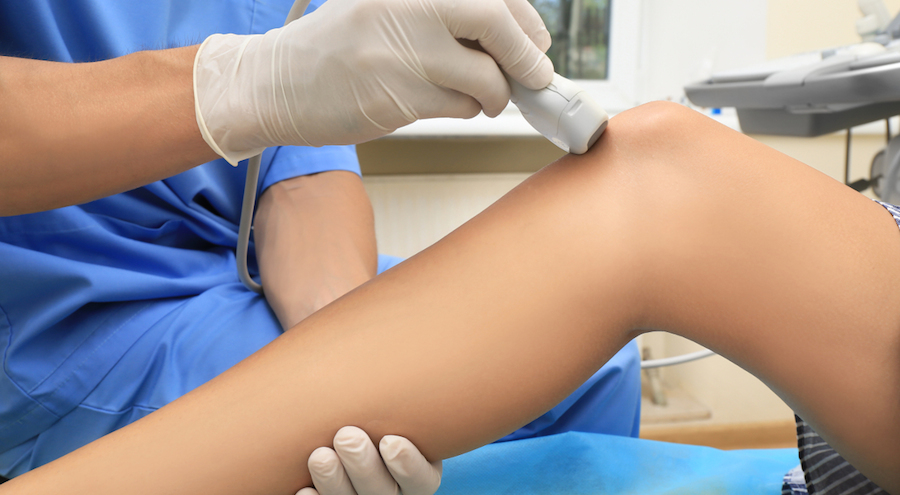
Patellar tendinitis is pain in the front of the knee, just below the kneecap, that appears above all in people who jump and run: basketball, volleyball, padel, running. Hence its other name, "jumper's knee". The problem is that it usually starts as a mild discomfort you can "put up with" during training, and precisely for that reason it often becomes chronic. Training on a tendon that hurts does not strengthen it: it gradually breaks it down. In this article you will see how to recognise patellar tendinitis, which exercises help, how long recovery usually takes and what is done in the clinic when it does not improve.
What Is Patellar Tendinitis?
The patellar tendon connects the kneecap to the shinbone and transmits the force of the quadriceps every time you straighten the knee. With repeated overload, that tendon becomes irritated and painful.
Doctors increasingly speak of tendinopathy rather than tendinitis. The reason is that, when the problem has been present for a while, what is found in the tendon is not so much acute inflammation as wear and a change in its structure. The nuance matters because it changes the treatment approach: it is not enough to "reduce inflammation and rest"; the tendon's capacity to bear load has to be rebuilt.
Symptoms and Phases
The key symptom is pain localised just below the kneecap. Its course usually follows fairly recognisable phases:
-
Early phase: pain only after physical activity.
-
Intermediate phase: pain when starting to train, which sometimes "warms up" and decreases during exercise, only to return afterwards.
-
Advanced phase: pain during and after activity, which starts to limit performance and everyday tasks such as going up and down stairs.
Recognising which phase you are in helps you avoid crossing the line that turns a manageable discomfort into an injury that takes months to heal.
Causes and Risk Factors
Patellar tendinitis is an overuse injury. The factors that contribute most are:
-
Repeated jumping and landing movements, typical of certain sports.
-
A sudden increase in load: more training, more intensity or more kilometres in a short time.
-
Hard surfaces and unsuitable footwear.
-
Muscle imbalances and poor flexibility in the quadriceps and hamstrings.
Exercises for Patellar Tendinitis
Well-dosed exercise is the basis of treating patellar tendinopathy. The idea is to load the tendon progressively so that it regains strength, without causing pain that makes it worse.
Isometric Exercises
These are sustained contractions without movement, useful in the more painful phases because they help reduce pain and allow you to start loading the tendon. One example is the isometric wall squat: you lean against the wall with your knees bent and hold the position for a few seconds.
Eccentric Exercises
These work the phase in which the muscle lengthens under load and are key to strengthening the tendon in the medium term. The classic exercise is the slow squat on an inclined surface, lowering in a controlled way. They are introduced when pain allows and progressed little by little.
What to Avoid While It Hurts
-
Raising the intensity suddenly or returning to jumping sports without a progression.
-
Abrupt, forced stretching of the painful tendon.
-
Prolonged complete rest: the tendon needs controlled load to recover, not total immobility.
Ideally a professional should guide the progression. A poorly dosed exercise plan, whether too much or too little, is one of the reasons this injury drags on.
Knee Straps and Taping: Do They Help?
Infrapatellar straps (a band placed over the tendon) and neuromuscular taping can offload the area somewhat and give a sense of support during activity. They are a reasonable temporary aid, but they do not cure the tendinopathy on their own: they do not replace the work of strengthening the tendon. Use them as a complement, not as a solution.
Treatment in the Clinic
When the pain does not improve with exercise work or has been present for a long time, an assessment is advisable to adjust the treatment. In the clinic several tools are combined:
-
Physiotherapy and rehabilitation, with a progressive loading programme adapted to your case and your sport.
-
Shockwave therapy in chronic forms. According to the available evidence, shockwaves can help reduce pain and stimulate tendon repair in tendinopathies that have not responded to other measures. We deliver this shockwave therapy treatment with STORZ MEDICAL technology, integrated into a rehabilitation plan.
You can see how we approach musculoskeletal injuries in the orthopaedics section.
Recovery Time
This is the most frequent question, and the honest answer is that it depends. It is influenced by the phase at which you start treatment, how long you had been in pain and, above all, how well you respect the loading progression. A recent, well-managed tendinopathy can improve in a few weeks; a chronic one usually needs several months of consistent work. What most prolongs recovery is returning to jumping sports too soon.
When to See a Doctor
Ask for an assessment if:
-
Knee pain lasts more than two or three weeks or returns every time you train.
-
You notice swelling, or the knee "gives way" or locks.
-
The pain appeared suddenly after a forceful movement, to rule out a tendon injury.
Shockwave therapy has contraindications (pregnancy, certain clotting disorders, infections in the area), so it is always assessed individually.
Frequently Asked Questions
Can I keep training with patellar tendinitis? Not in the same way. Keeping up the training that causes pain usually worsens the injury. Normally the activity is adapted - reducing jumping and impact - and replaced with controlled-load exercises while the tendon recovers. The specific plan should be guided by a professional.
Is it the same as patellar chondromalacia? No. Patellar tendinitis affects the tendon, while chondromalacia affects the cartilage of the kneecap. They can cause pain in similar areas, but they are different problems with different treatments.
How many shockwave sessions are needed? The usual approach is several sessions spaced roughly one a week, and the exact number depends on each person's response. The doctor adjusts it after assessing you.
Book Your Consultation
If pain below the kneecap accompanies you in every training session, do not wait for it to become chronic. After the first assessment we design a personalised plan to recover the tendon and return to your activity safely.
-
Book an appointment: Book a consultation
-
WhatsApp: +34 624 00 62 44
-
Phone: +34 624 00 62 44
-
Address: Carrer de Santaló, 105 · 08021 Barcelona