
Neurology & brain health
Brain neuroplasticity: how your brain keeps changing at any age
July 6, 2026 · 4 min ·
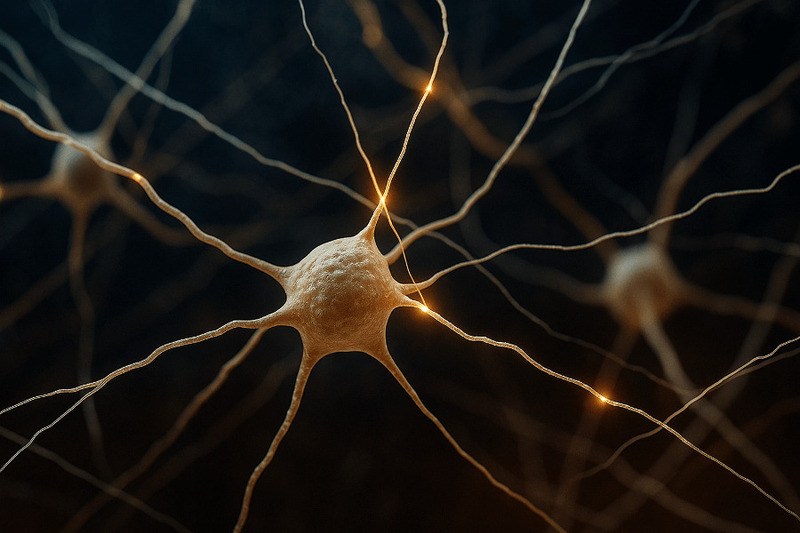
For decades, science believed the adult brain was a fixed structure: you are born with a certain number of neurons, you lose them over the years, and there is no way back. This idea, reassuring in its simplicity, turned out to be wrong.
Today we know that the human brain has a remarkable capacity to reorganise itself, to create new connections and even to form new nerve cells throughout life. This phenomenon is called neuroplasticity, and it is one of the most important discoveries in modern neuroscience. Whether you are 30, 55 or 75, your brain is still capable of changing.
The question, then, is not whether the brain can adapt after a certain age. It can. The question is what we can do to activate that capacity — and what happens when we do not. This article explains what neuroplasticity is, how it works, why it slows down over the years and, above all, what tools exist today to stimulate it.
What is neuroplasticity?
Neuroplasticity — also called neural or brain plasticity — is the brain’s ability to change its structure and functioning in response to experience, learning, environment or injury. Put simply: the brain is not rigid, but plastic. Every time you learn something new, refine a skill or adapt to an unfamiliar situation, your neural networks reorganise.
The concept is not entirely new. As far back as 1890, the psychologist William James suggested that the nervous system had a certain “plasticity”. But it was not until the end of the 20th century that neuroimaging research — above all functional MRI — made it possible to observe in real time how the brain rewires itself. It was shown, for example, that London taxi drivers have a larger-than-average hippocampus, developed through the constant need to memorise routes. Or that professional musicians show thickening in the brain areas linked to fine motor control and hearing.
These discoveries changed our understanding of the brain forever: it is not an organ that passively degrades, but one that actively responds to what we demand of it.
How does brain plasticity work?
Brain plasticity is not a single mechanism but a set of processes operating at different levels. Three of them are especially significant.
Synaptic plasticity: strengthening connections
Neurons communicate with one another through synapses — the points of contact where electrical and chemical signals are transmitted. Synaptic plasticity is the ability of these connections to strengthen or weaken depending on use. It is the principle summed up in the famous phrase of the neuroscientist Donald Hebb: “neurons that fire together, wire together”.
When you repeat an action, study a topic or hone a skill, the synapses involved strengthen. The circuits become more efficient, the signal travels faster and the cognitive effort decreases. This is what happens when you go from driving with conscious effort to doing it automatically. And it is also the biological basis of memory and learning.
The reverse is also true: neural connections that stop being used weaken and are eventually eliminated. The brain “prunes” what it does not need. That is why constant stimulation is so important.
Neurogenesis: can new neurons be created?
For a long time it was thought that we are born with all the neurons we will have throughout life. Research has substantially refined that belief. According to the available studies, neurogenesis — the formation of new neurons — occurs in at least two regions of the adult brain: the hippocampus (essential for memory) and the olfactory bulb.
Hippocampal neurogenesis is especially significant in the context of ageing and neurodegenerative diseases. The evidence suggests that factors such as aerobic physical exercise, learning, an enriched environment and the reduction of chronic stress can promote the production of new neurons. Conversely, a sedentary lifestyle, social isolation and chronically elevated cortisol levels suppress it.
The role of vascularisation: new blood vessels in the brain
A less well-known but no less important aspect: for neurons to function — both the existing ones and the new ones — they need a constant supply of oxygen and nutrients. This supply is provided by the blood vessels. The formation of new vessels in brain tissue — a process called neoangiogenesis — is one of the pillars of brain plasticity.
When the brain’s vascularisation improves, blood flow increases, neuronal metabolism is optimised and communication between neurons becomes more efficient. It is precisely this mechanism that some of the most advanced neurostimulation methods exploit, as we will see below.
Neuroplasticity after 50: is it possible?
Yes. Without reservation. Neuroplasticity does not disappear at 50, nor at 60, nor at 80. What changes is its speed and intensity.
With age, the processes of brain plasticity naturally slow down. The formation of new synapses is slower, neurogenesis decreases and the brain’s vascularisation tends to diminish. This does not mean the brain stops being plastic; it means it needs more stimulation to activate the same mechanisms that, at 20, worked almost automatically.
This is the key distinction: the potential is still there, but it has to be sought out actively.
The problem arises when this natural slowdown combines with factors that accelerate it: physical inactivity, isolation, chronic stress, poor diet, sleep disturbances or cardiovascular disease. In these cases, brain plasticity declines to a point at which the symptoms of cognitive decline begin to appear — frequent forgetfulness, difficulty concentrating, disorientation.
And here neuroplasticity is directly linked to diseases such as Alzheimer’s. In the early stages of the disease, the brain still retains a considerable capacity for compensation: it redistributes functions, strengthens alternative circuits and uses “detours” to maintain cognitive performance. But this compensatory capacity has a limit. That is why early intervention is so decisive: the sooner the residual plasticity is stimulated, the longer functionality is preserved.
Factors that stimulate neuroplasticity
Neuroplasticity does not activate on its own. It responds to specific stimuli. Here are the ones with the strongest scientific support.
Physical exercise and its effect on the brain
Aerobic exercise — brisk walking, swimming, cycling — is probably the most powerful and accessible enhancer of neuroplasticity there is. Physical activity increases the production of BDNF (Brain-Derived Neurotrophic Factor), a protein that acts as a “fertiliser” for neurons: it promotes the survival of existing ones, stimulates neurogenesis and supports the formation of new synapses.
According to several studies, just 30 minutes of moderate exercise a day can have a measurable effect on the structure and functioning of the brain, especially the hippocampus.
Continuous learning and cognitive stimulation
Learning a language, playing a musical instrument, studying a new subject, solving complex problems… Any activity that makes the brain work outside its comfort zone activates synaptic plasticity. Routine and mechanical repetition do not help: the brain needs novelty and challenge to reorganise.
Structured cognitive stimulation — exercises in memory, attention and reasoning designed by specialists — is especially effective in older adults at risk of decline or in the early stages of dementia.
Restorative sleep and nutrition
Sleep is the moment when the brain consolidates what it has learned during the day, removes metabolic waste and “resets” neural circuits. Poor sleep does not only affect cognitive performance the next day: in the long term, chronic sleep deprivation reduces the brain’s ability to form new connections.
As for nutrition, the Mediterranean diet — rich in omega-3 fatty acids, antioxidants, vegetables, legumes and olive oil — is consistently associated with a lower risk of cognitive decline. This is not magic: it is biochemistry. The brain needs specific nutrients to produce neurotransmitters, maintain neuronal membranes and fight oxidative stress.
Social ties and emotional health
Social isolation is one of the most powerful risk factors for cognitive decline. Conversing, debating, negotiating, empathising — all the mental operations that social life involves keep broad and varied neural networks active. Conversely, prolonged loneliness is associated with reduced brain volume and an increased risk of dementia.
Emotional health matters too: sustained chronic stress creates a neurochemical environment hostile to plasticity. To look after the mind is, quite literally, to look after the brain.
Methods that activate neuroplasticity
Beyond lifestyle, medicine has developed tools that act directly on the mechanisms of brain plasticity.
Transcranial brain stimulation (TPS): how it acts
Transcranial pulse stimulation (TPS) represents one of the most significant advances in non-invasive neurostimulation. By means of focused, low-energy acoustic pulses, the device precisely stimulates specific brain regions, activating exactly the three pillars of neuroplasticity we have described:
-
Neoangiogenesis: It promotes the formation of new blood vessels in brain tissue, improving blood flow and the supply of oxygen and nutrients to neurons.
-
Improved neuronal communication: According to the clinical data, the stimulation optimises signal transmission between neurons, strengthening synaptic connections.
-
Neurochemical regulation: The available data point to an increase in levels of serotonin and dopamine — neurotransmitters involved in motivation, attention and cognitive functions.
The results are measurable: according to the studies carried out with the NEUROLITH device, patients show improvements in attention, orientation and memory three months after treatment. The procedure is outpatient (six sessions of 30 minutes over two weeks), painless and with no adverse side effects identified.
At Clínica Revita in Barcelona we use TPS therapy with NEUROLITH as a neurostimulation tool for patients with cognitive decline, Alzheimer’s disease in its early stages, the after-effects of trauma and concussions, and age-related degenerative changes. It is a complementary approach that acts where cognitive exercises cannot reach: directly on the biology of the brain.
Neuroplasticity and neurodegenerative diseases
Neuroplasticity is not just a fascinating concept for popular-science writers. It is a clinical reality with direct consequences for millions of patients with neurodegenerative diseases.
In the case of Alzheimer’s disease, the illness progressively destroys neurons and synaptic connections, beginning in the hippocampus and then spreading to other areas. But the brain does not give up without a fight. In the early stages, brain plasticity makes it possible to compensate for part of the damage: other neurons take over the functions of those lost, alternative pathways are strengthened, and the patient can maintain a reasonable level of functioning for some time.
This period of compensation is a window of opportunity for intervention. If during this phase neuroplasticity is actively stimulated — with exercise, cognitive stimulation, social life and, where indicated, brain-stimulation methods such as TPS — the stage at which the patient retains autonomy and quality of life can be significantly prolonged.
Ultimately, neuroplasticity teaches us that the brain is not condemned to passive decline. It has the tools to defend itself. Our task — as patients, as relatives, as health professionals — is to give it the resources to do so.
Would you like to know what state your brain is in?
At Clínica Revita (Barcelona) we carry out complete neurological evaluations to determine your current cognitive level and design an individualised stimulation plan. We offer access to TPS therapy with NEUROLITH — the only brain-stimulation device of this type with CE marking in the EU.
📞 Call us at +34 624 00 6244 or visit us at Carrer de Santaló, 105, 08021 Barcelona.